What “Overwatering” Really Means
Gardening customers across Central Texas often tell us the same thing: “I’m afraid of overwatering my plants.” That fear causes many container plants to decline long before summer heat arrives. Ironically, most struggling potted plants suffer from incomplete watering, not too much water at one time. “I don’t want to overwater so I just give it a little bit” is something I hear almost every day.
True overwatering does not happen because you applied a generous amount of water during one watering session. Overwatering occurs when roots stay deprived of oxygen for extended periods. Healthy roots need both water and air. A properly watered container should contain roughly 50% water and 50% air-filled pore space after excess water drains away.
Many gardeners stop watering as soon as water exits from the drainage holes. Unfortunately, dry potting soil often channels water straight through the container while large sections of the root ball remain dry. The result is a stressed root system hidden inside a seemingly wet pot.
Understanding how potting soil hydrates will completely change how you water container plants.
Dry Potting Soil Repels Water
Most commercial potting soils contain bark, peat, composted forest products, and other organic materials rich in lignins. Lignins naturally become hydrophobic when they dry out. Hydrophobic materials repel water instead of absorbing it evenly.
This is especially common during Central Texas summers when containers bake in triple-digit temperatures. The potting mix shrinks away from the sides of the pot and creates dry channels. When you water quickly, the water races through those channels and exits the drainage holes before fully soaking the root zone.
Many gardeners mistakenly think drainage water means the soil is saturated. In reality, the root ball may still contain large pockets of dry substrate.
That is why thorough watering matters.
Why You Should Water in Stages
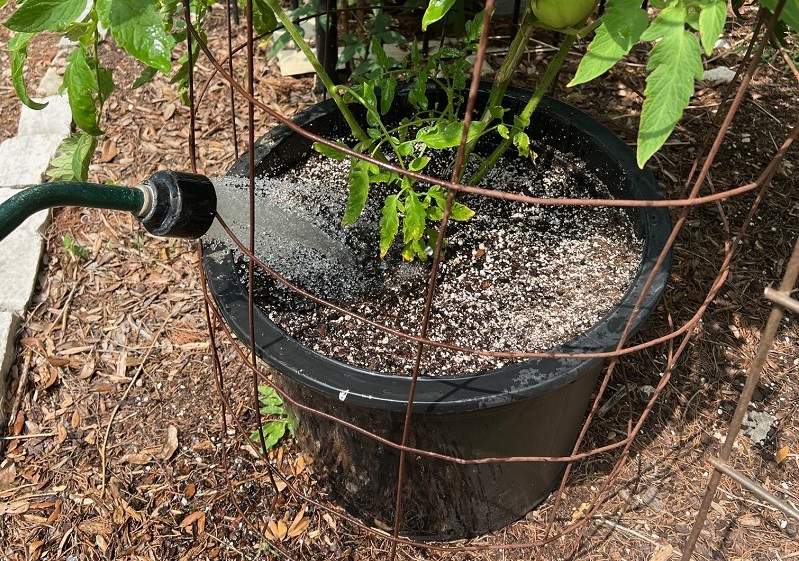
When watering a potted plant, apply water repeatedly, filling the reservoir area at the top of the pot each time. The first application begins rehydrating the dry substrate. The second and third applications help break surface tension and fully saturate the potting mix.
As water enters dry soil, you may notice bubbles rising to the surface. Those bubbles are important. They show that water is displacing trapped air pockets inside the dry root ball.
Do not stop watering when bubbles first appear. Continue applying water until bubbling slows or stops. At that point, water has replaced most of the trapped air in the dry areas of the substrate.
This process restores uniform moisture throughout the container instead of creating isolated wet and dry zones.
What the Bubbles Mean
The bubbles you see during watering are not harmful. They are evidence that hydration is finally reaching dry portions of the soil profile.
Think of a dry sponge submerged in water. Air escapes as water fills the empty spaces. The same thing happens inside a container plant.
When bubbles stop appearing, the substrate has usually accepted water more evenly throughout the container. That means roots can access moisture throughout the entire pot instead of only in isolated pockets.
Many gardeners stop watering too soon because they fear drowning the roots. In reality, they often leave large sections of the root system dry and unable to function properly.
Click HERE to watch video on watering outdoor potted plants correctly
The Cohesive Properties of Water Protect Root Health
Water behaves in fascinating ways inside potting soil. Water molecules are strongly attracted to one another through cohesion. This attraction helps water move through soil particles and root systems efficiently.
As gravity pulls excess water downward through the drainage holes, cohesive forces cause water molecules to cling together while still moving as a connected column. As that excess water drains away, it leaves behind essential pore spaces filled with oxygen.
Those oxygen-filled pores keep roots alive.
Without pore space, roots suffocate. Roots require oxygen to perform respiration, absorb nutrients, and support healthy growth.
That is why drainage holes are critical.
Healthy Potting Soil Contains Both Water and Air
Many gardeners imagine healthy soil as completely saturated soil. In reality, ideal container media contains a balance of moisture and oxygen after drainage occurs.
Professional horticulturists often describe this as approximately 50% water-filled pore space and 50% air-filled pore space.
Immediately after thorough watering, gravity removes excess water through the drainage holes. Since water molecules are attracted to each other there is an additional pull involved that removes excess water /What remains behind is the perfect balance roots need.
This is why a deep watering does not automatically create overwatering conditions.
Overwatering Is Really About Oxygen Deprivation
Real overwatering happens when pore spaces remain filled with water for too long. Roots then lose access to oxygen.
Several conditions cause this problem:
- Pots without drainage holes
- Containers sitting in water-filled saucers
- Dense soils that stay compacted
- Watering too frequently before oxygen returns
- Poor-quality potting media
- Adding gravel to the bottom of the pot Click HERE to learn why this is NOT RECOMMENDED
Notice that the problem is not the amount of water applied during one watering session. The problem is stagnant water replacing oxygen for extended periods.
Why Saucers Cause Problems
Decorative saucers trap drainage water beneath containers. Many gardeners assume the plant will “drink what it needs,” but that standing water creates serious root issues.
As the pot sits in collected runoff, the potting mix wicks water back upward through capillary action. The lower portion of the root ball stays saturated, and the pore spaces that should contain oxygen refill with water.
Over time, roots begin to suffocate.
Saturated conditions encourage root rot pathogens such as Pythium and Phytophthora, especially during warm weather in Central Texas.
If you are watering an indoor houseplant, click HERE for video on how to water properly. It really makes a difference!
Outdoors, avoid saucers entirely whenever possible, or move them off the saucer to water then set them back when pot has completely drained excess water.
The BEST Way to Grow Plants in Pots
My “Tried and True” method for growing plants in pots is very simple.
DO NOT PLANT DIRECTLY INTO CERAMIC OR DECORATIVE POTS!
Use a plastic nursery pot and set it down into the decorative pot. This is called “double potting”.
Here are some good reasons why you should double pot plants growing both inside and outside your house:
- It will be easier to transplant the plants when the time comes. Try getting an intact rootball out of a ceramic pot!
- Tropical plants will be lighter in plastic pots and can easily be moved inside to protect from cold temperatures.
- You can gauge the dryness of the soil by lifting the pot. When it begins to become lighter it will be time to water. No brainer!
- Indoor plants can be easily taken to a sink, bathtub or outdoors to thoroughly water, then replaced into the decorative pot.
Deep Watering Builds Stronger Roots
Plants watered lightly and frequently often develop shallow, weak root systems. Water never penetrates deeply enough to encourage roots to expand throughout the container.
Thorough watering promotes stronger root growth because moisture reaches the entire root zone. Strong roots improve drought tolerance, nutrient uptake, flowering, and overall plant performance.
Healthy watering practices become even more important in Central Texas landscapes where summer stress pushes container plants to their limits.
The next time you water your pots, do not fear applying enough water. Fear incomplete hydration instead.
A properly watered container should drain freely, contain both water and oxygen, and support a fully hydrated root system from top to bottom. When you see bubbles escaping from the soil surface, remember that you are not finished watering your plant. Continue to apply water until the bubbling stops or water slows its percolation through the soil.
That is not overwatering.
That is proper horticulture