Why Isn’t My Fig Tree Producing Fruit?
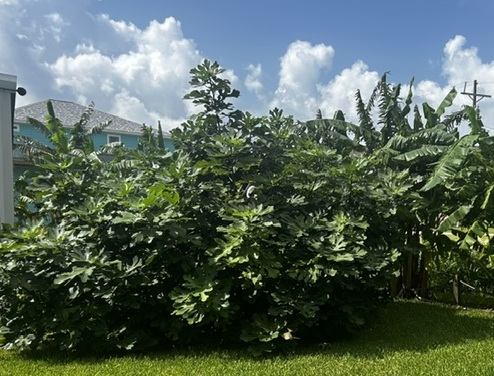
If your fig tree is covered in lush green leaves but refuses to produce fruit, you’re not alone. This is one of the most common questions we hear from Central Texas gardeners. The good news is that fig trees are usually reliable producers once they become established. When they don’t fruit, the cause is often something you can correct.
I’ve heard it mentioned that some people have not seen a lot of bees around their tree. Rest assured, the figs grown in our area do not require pollination at all. The figs grown in our area are “parthenocarpic“, which means they develop fruit without pollination. Figs in other parts of the world are pollinated by tiny fig wasps, but the figs we grow in Central Texas luckily do not require them. That’s great, because the fig wasps do not live here!
Understanding how fig trees grow and produce fruit will help you identify the problem and get your tree back on track.
How Fig Trees Produce Fruit
One of the most important things to understand about figs is that they can produce two different crops each year.
The Breba Crop
The breba crop develops on last year’s wood, also called old wood. Tiny fruit buds form during the previous growing season, survive the winter, and mature into figs the following spring or early summer.
Not every variety produces a significant breba crop. Some varieties produce only a few breba figs, while others produce an abundant early harvest.
The Main Crop
The main crop develops on new growth produced during the current growing season. This crop is usually much larger and more dependable than the breba crop, especially in Central Texas.
Because the main crop forms on new shoots, healthy spring growth is essential for a productive harvest.
Understanding the difference between these two crops helps explain why improper pruning or winter damage can dramatically reduce fruit production.
1. Your Fig Tree May Be Too Young
Patience is often the hardest part of growing fruit trees.
Most fig trees begin producing fruit within two to five years after planting. Trees grown from cuttings often fruit sooner than those grown from seed.
Young trees spend their first several years developing a strong root system and sturdy framework before putting significant energy into fruit production.
During this establishment period, focus on healthy growth instead of expecting large harvests. Learn how to establish trees successfully HERE
2. Excess Nitrogen Encourages Leaves Instead of Fruit
One of the biggest reasons fig trees fail to fruit is excessive nitrogen fertilizer.
Nitrogen promotes vigorous leafy growth. While a healthy canopy is important, too much nitrogen signals the tree to invest its energy in stems and leaves instead of flowers and fruit.
Common sources of excess nitrogen include:
- Lawn fertilizers reaching the root zone. Weed and Feed Products, which should NEVER be used on a lawn in Central Texas, typically contain up to 30% Nitrogen. Since the tree roots may grow out into the lawn area, this could cause excessive foliar growth at the expense of fruit production.
- High-nitrogen fertilizers applied too frequently. Instead, use an organic form of nitrogen, such as MicroLife 6-2-4. MicroLife fertilizer information may be found HERE
- Fresh manure applied around the tree. Boy Howdy. Does anyone do this?
A soil test is the best way to determine exactly what your tree needs before adding fertilizer.
3. Over-Pruning Can Remove Next Year’s Crop
Pruning mistakes are another common reason figs fail to produce.
Remember:
- Breba figs grow on old wood.
- Main crop figs grow on new growth.
Heavy winter pruning removes much of the wood that would have produced the breba crop. Severe pruning also forces the tree to spend the season replacing branches instead of producing fruit.
Fortunately, fig trees recover quickly, but they may sacrifice fruit production for a season while rebuilding their canopy.
How to Prune Fig Trees
Fig trees require surprisingly little pruning.
Instead:
- Remove dead or damaged branches.
- Eliminate crossing branches.
- Thin crowded areas to improve air circulation.
- Maintain an open canopy that allows sunlight to reach the interior.
Avoid shearing or aggressively topping mature trees unless rejuvenation is necessary.
4. Strong Roots Produce Better Fruit
Healthy roots are the foundation of a productive fig tree.
Many gardeners focus only on what they see above ground, but a fig tree depends on a broad, spreading root system to absorb water and nutrients throughout the year.
As roots expand, they store carbohydrates that fuel spring growth and fruit production.
Tree roots can grow one to two times the height of the tree out from the tree in all directions. This is where water and nutrients should be applied, or at least to the edge of the canopy.
Roots can grow all winter in Central Texas. On established Figs, if we don’t receive an inch of rain in a three to four week time period, apply and inch of water at least under the entire canopy of your Fig.
Encourage a Healthy Root System
Help your fig develop an extensive root system by:
- Watering deeply rather than frequently, not just at the base of the tree, but under entire canopy
- Applying two to four inches of mulch around the tree. Mulch helps conserve moisture and prevents grass and weeds from competing for water and nutrients
- Keeping mulch several inches away from the trunk
- Avoiding soil compaction over the root zone
- Allowing roots room to spread instead of planting too close to structures
Established fig trees tolerate drought remarkably well, but consistent moisture during fruit development produces larger, sweeter figs.
5. Spring Freezes Can Destroy the Breba Crop
Central Texas weather is unpredictable.
Late freezes occasionally damage overwintering fruit buds on old wood. When this happens, the breba crop may disappear entirely.
Fortunately, healthy trees usually produce a normal main crop on new growth later in the season.
This is one reason many Central Texas gardeners rely more on the main crop than the breba harvest.
6. Too Much Shade Reduces Fruit Production
Fig trees thrive in full sun.
Provide at least six to eight hours of direct sunlight every day. Trees growing in partial shade often produce fewer figs and less vigorous new growth.
Sunlight also improves fruit sweetness and overall quality.
7. Water Stress Can Cause Fruit Problems
Fig trees appreciate consistent moisture, especially during periods of active growth and fruit development.
Extreme drought can cause:
- Poor fruit set
- Small figs
- Premature fruit drop
- Reduced harvest
On the other hand, constantly wet soil can damage roots and reduce overall tree health.
Deep, infrequent irrigation encourages roots to grow deeper into the soil, creating a stronger, more resilient tree.
Growing Figs Successfully in Central Texas
Fortunately, figs are well adapted to our climate.
Popular varieties such as ‘Celeste,’ ‘Texas Everbearing,’ ‘Brown Turkey,’ and ‘LSU Purple’ perform well across much of Central Texas because they tolerate summer heat and generally produce dependable main crops.
With proper care, mature fig trees often reward gardeners with abundant harvests year after year.
Quick Checklist for Better Fig Production
If your fig tree isn’t fruiting, ask yourself these questions:
- Is the tree at least two to five years old?
- Does it receive six to eight hours of full sun?
- Has it been heavily pruned?
- Is it receiving too much nitrogen?
- Are you watering deeply during dry periods?
- Does it have room to develop a broad root system?
- Could a late freeze have damaged the breba crop?
Correcting even one of these issues often leads to improved fruit production the following season.