TEXAS NATIVES · GARDEN HISTORY · CENTRAL TEXAS
The History Behind Plant Names in Central Texas
Ever wonder who we’re honoring when we plant autumn sage or Lindheimer’s daisy? Behind those Latin names are stories of frontier exploration, scientific discovery, and a lifelong love of Texas wild places.
If you spend enough time exploring native Texas plants, you’ll start to recognize familiar names in their scientific labels. Greggii and lindheimeri are two particularly meaningful examples. They connect our gardens to the 19th-century explorers and plant collectors who helped introduce Texas’s remarkable flora to the scientific world.
Josiah Gregg: The explorer behind autumn sage

Josiah Gregg (1806–1850) was an American explorer, writer, and naturalist whose travels took him across the American Southwest and northern Mexico. He first became widely known for his account of the Santa Fe trade, Commerce of the Prairies, published in the 1840s.
During his travels, Gregg collected plant specimens and corresponded with prominent botanists, including George Engelmann in St. Louis. Botanists later honored him by naming numerous plants after him.
One of the best-known examples is Salvia greggii — our beloved autumn sage. With its colorful blooms, drought tolerance, and appeal to hummingbirds, it’s a Central Texas garden favorite.
The species was formally described by Harvard botanist Asa Gray in 1872, using material associated with Gregg’s collecting work. Gregg’s botanical travels included western Texas and northern Mexico, although the precise collection history of individual plants matters: not every species bearing his name was collected within Texas itself.
Another example is Conoclinium greggii, a name associated with Gregg in botanical literature. Plant names and classifications can change as botanists revise their understanding of relationships between species, so it’s worth checking the currently accepted name when researching a particular wildflower.
Ferdinand Lindheimer: The father of Texas botany

Ferdinand Lindheimer (1801–1879) has a particularly strong connection to Central Texas. Born in Frankfurt, Germany, he immigrated to America in 1834 and eventually settled in New Braunfels.
Working with botanists George Engelmann and Asa Gray, Lindheimer collected thousands of plant specimens across Texas. His collecting grounds included the Gulf Coast, southeastern Texas, and the country around New Braunfels and the Comal River. He became known as the “Father of Texas Botany.”
Unlike many botanists of his era, Lindheimer was primarily a field collector rather than the person who formally named every plant he discovered. He sent his specimens to specialists who examined, described, and classified them. Their publications helped bring Texas plants to the attention of scientists around the world.
A wonderful example is Lindheimeria texensis , commonly called Lindheimer’s daisy. This yellow-flowered native is a fitting tribute to the man who devoted so much of his life to documenting Texas’s flora. Another example is Ipomoea lindheimeri, Lindheimer’s morning glory, which was collected near New Braunfels in 1851.
Many other Texas plants bear his name, including Lindheimer’s muhly aka Big Muhly (Muhlenbergia lindheimeri) and Lindheimer’s senna (Senna lindheimeriana).
What about Gregg’s mistflower?

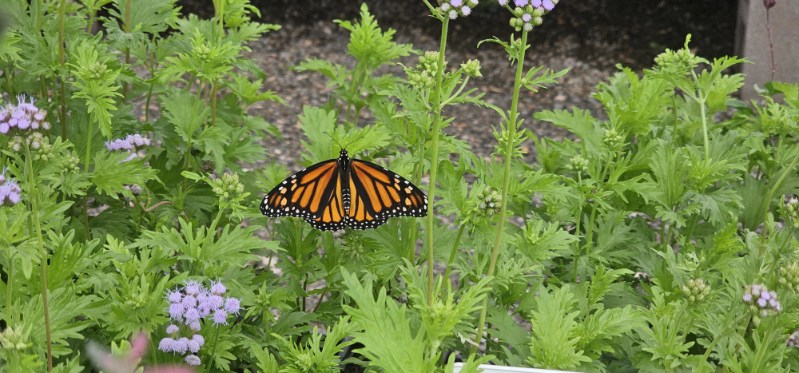
Conoclinium greggii, often called Gregg’s blue mistflower, is another familiar name in Central Texas gardens. Its fluffy blue-purple flower clusters are magnets for butterflies, making it a valuable addition to pollinator gardens.
The name honors Josiah Gregg, whose travels and plant-collecting efforts helped document the flora of Texas and the Southwest. Gregg’s travels through Texas included the Red River region, Nacogdoches, Galveston, and Austin.
There is one botanical wrinkle: Conoclinium greggii is now treated as a synonym of Conoclinium dissectum by major taxonomic databases. You may also encounter the older name Eupatorium greggii. Plant labels and references do not always use the same name, even when they refer to the same plant.
A living connection to Texas history
The next time you see autumn sage flowering along a limestone path, Gregg’s mistflower covered in butterflies, or Lindheimer’s daisy brightening a sunny bed, remember that these plants carry more than botanical labels. They preserve the names of people who explored unfamiliar landscapes, gathered specimens under difficult conditions, and helped establish our understanding of Texas’s native flora.
For Central Texas gardeners, that history is a reminder that growing native plants is also a way of keeping our natural heritage alive. Every native plant in the garden connects us to the landscapes that inspired those early collectors — and to the generations of Texans who continue to study, protect, and enjoy them.
For further reading: The Texas State Historical Association’s biographies of Josiah Gregg and Ferdinand Lindheimer, along with the University of Texas Biodiversity Center’s history of Lindheimer, offer a deeper look at these remarkable early naturalists.