

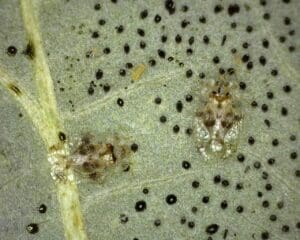
 We’ve had a lot of samples of Texas Persimmon brought into the nursery lately with Lace Bug infestations. The leaves appear “mottled” from the insects feeding with their sucking mouthparts. The undersides of the leaves will have little black “dots” which are the insect’s excrement. This insect is tiny but visible to the naked eye. It is named for the lacey appearance of its wings.
It may be helpful to know that this insect is also a pest on Bur Oak and Lantana in Central Texas. Keep an eye out and check the undersides of the leaves when it starts to get hot.
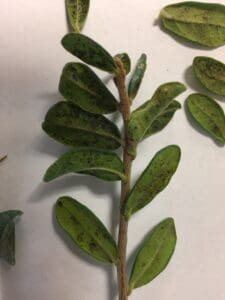
The good news is that the feeding of this insect rarely causes permanent damage, it is just unsightly for a while. The leaves will fall and you should rake them up and dispose of them. If this happens in the summer, the tree will likely push out more leaves soon. If you see it in the fall the leaves are getting ready to drop anyway, so little harm is done. In many cases, by the time you notice it the damage is done and I’m not sure that spraying for control is justified. Inspect the new leaves when they emerge and at the first sign of Lace Bugs you may consider treating.
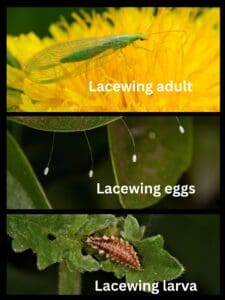
It is interesting that a similarly-named insect is an important predator of the destructive Lace bug. It is called a “Lacewing” and it is aptly named for the somewhat different lacey appearance of its wings as well.
I usually find Lacewing eggs and larvae on plants with Lace Bugs, consuming as many as they can. You have probably noticed the tiny white eggs on “stalks” on your plants and wondered what they were. These beneficial insects will help control populations of many harmful insects.
If you aren’t familiar with these wonderful beneficial insects, you can read about them HERE.
It is important to know that while the following treatments are “organic” they will still harm beneficials that are on the tree with the Lace Bugs.
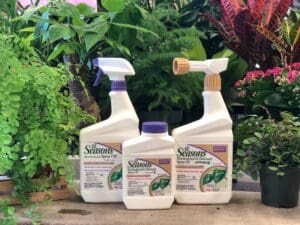 My “go-to” for Lace Bugs is Bonide All Seasons Oil, but the conditions have to be just right for it to work properly and not damage the tree. Temperatures between 45° and 85°F and LOW HUMIDITY (below 50%) for fast drying conditions are required. The oil dries fast and suffocates the insect. So you can see that conditions are not right to apply it in the middle of the summer or after rain, since temperatures and/or humidity might be high.
Please note that any “oil product”, including Neem, can damage plants at high temperatures.
ALWAYS read the label and follow directions exactly.
I highly recommend spraying the tree with the All Seasons Oil in February when the tree has no leaves, under the same temperature and humidity conditions described above. It will help control overwintering insects such as Lace Bugs. The Lace bugs overwinter under bark and in leaf litter around the tree. (Which is why CLEAN UP is so important!)
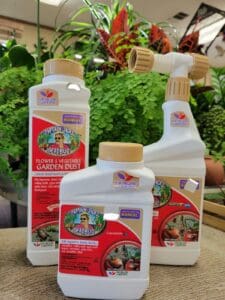
Spinosad (Captain Jack’s Deadbug Brew) is also labeled for and effective for Lace Bugs, but it will also harm pollinators and soft-bodied beneficial insects such as Lacewing larvae that are probably already present on the tree. You should evaluate the severity of the infestation and whether there is still a large population present before making the decision to treat.
We usually see higher populations of insects on drought stressed trees, and with the drought we’ve been experiencing since 2023 it is not surprising.
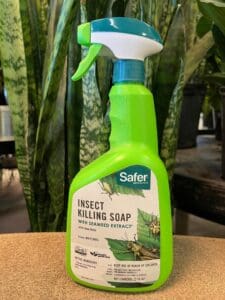
Insecticidal soap or Spinosad soap is also useful to treat soft-bodied insects. Again, consult the label for the conditions that are appropriate to apply each product.
I cannot stress the importance of CLEAN UP, CLEAN UP, CLEAN UP, no matter if it is insects or disease that you are dealing with. It will go a long way in preventing future infestations. Rake up those leaves, bag them in place and dispose of them. Do not compost them!
Sign up for our weekly newsletter here https://backbonevalleynursery.com/
Email me: [email protected]
We’d love to see you at the nursery. We promote native plants and try to recommend organic methods when appropriate.


Leave A Comment