


Webs Forming at Tips of Tree Branches
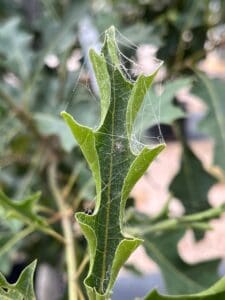
Has anyone seen tips of tree branches that are covered in spider webs? We have! Ground spiders will often form disorganized webs at the tips of tree branches and raise their brood of thousands of tiny spiders there. Fortunately most of these webs are made by these harmless and beneficial spiders, and not by pests at all.
This web was made by a spider on a leaf of a young Live Oak.
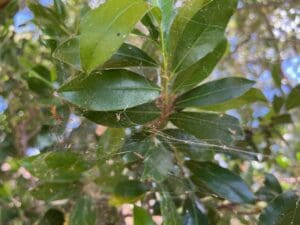
We have seen examples of these webs on Live Oaks, Crape Myrtles, Cherry Laurels, Yaupon Holly and Cedar Elm trees, as well as many varieties of shrubs. Spiders are an important part of nature and may be found just about anywhere. Since these are actually beneficial insects, chemical control is not often warranted.

Because their webbing activity may cause dead leaves or unsightly tips to the branches, you might use a high pressure spray to knock them out of the trees. This example is a Lynx spider on the spent bloom of a rose bush. You can even see the tiny spiders that have hatched crawling around in the web. If you wish, you can carefully trim the spent bloom off and lay at the base of the rose bush.

Since it is important to know if the webs are caused by regular spider or harmful spider mites, here are some photos of what you would see if spider mites were present.
This is a spider mite web on an Italian Cypress. It is much finer than a regular spider web. The tiny spider mites are much smaller than regular spider babies.
Click HERE to learn how to determine if your tree has spider mites.

This is a close up of spider mites on a Pittosporum shrub. Although tiny, they are visible to the human eye.

Here is another example of spider mites, this time on a juniper. You can see how the “good” spiders might be confused with the “bad” spider mites. Be sure to look closely so that you don’t use pesticides needlessly.




Leave A Comment