TIPS FOR YOUR
GARDEN & LANDSCAPE

Preparing for a Fall Garden

Preparing Your Central Texas Garden for Fall Planting Preparing your garden for fall planting in Central Texas involves improving the soil by adding amendments to help plants grow and thrive. It’s easy to get excited about planting a fall vegetable garden in Central Texas. After pulling out tired spring plants, the garden can look bare and unfinished. Then you start thinking about crisp lettuce, fresh broccoli, carrots, and other cool-season vegetables—and suddenly you’re ready to plant! Before you put those first fall transplants or seeds in the ground, take some [...]

By |2026-08-22T15:53:41-05:00August 15th, 2017|Vegetable Gardening|

Planting for Butterflies

Working in a nursery certainly has its advantages. When the butterflies are out in force, it is a show-stopping display! Most of you know that butterflies have less specific “nectar” plants for the adult butterflies and more specific “food” plants for the caterpillars. It is interesting that the adults will often scope out where to lay their eggs while they are feeding on nectar. For this reason, it is helpful to have some of the “food” plants nearby when planting your nectar garden. An example of a “food” plant for [...]

By |2020-07-22T16:37:46-05:00August 9th, 2017|Plants|

August Gardening Checklist

August Gardening Checklist Gardening in August in Central Texas is always a challenge. However, there are some timely activities that can and should be addressed this month. Watering should take center stage, with infrequent, deep watering preferred to frequent, shallow watering. Watch our video on how to determine how long and how often to water your lawn HERE. Annuals and perennials: There is still time to plant heat-loving annuals in those bare spots in the landscape. Many of the heat-lovers, such as Vinca, Angelonia and Penta will thrive all the [...]

By |2026-07-29T13:14:16-05:00August 1st, 2017|Monthly Gardening Checklist|

Lace bug Damage on Lantanas

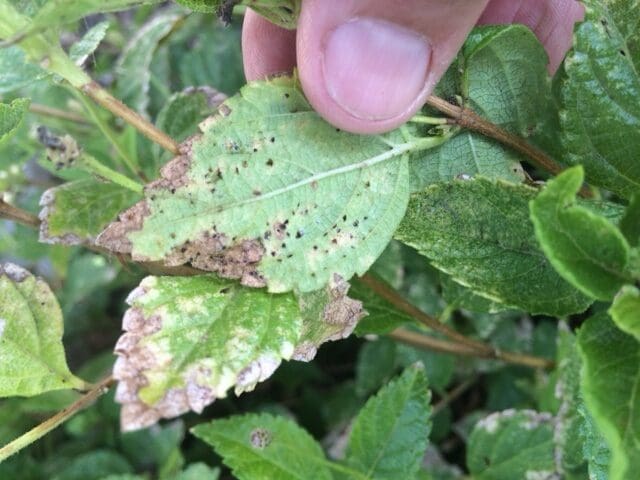
Lace bug damage usually occurs on Lantanas in mid to late summer.  The leaves will appear “bleached-out”, and there will be black specks on the back of the leaves, which is the excrement of the insect. Cut the plants back to about one foot by one foot if badly damaged. Bag the clippings "in place" and rake the leaves up as well. Dispose of clippings and leaves in the garbage and do not compost. Cleaning up and removing infected plant material will help eliminate overwintering insects that could reinfect the [...]

By |2025-08-17T08:37:58-05:00August 1st, 2017|Insects|

Citrus Varieties in Central Texas

Improved Meyer Lemon:  The original Meyer lemon was introduced from China by plantsman Frank Meyer. It is believed to be a cross between and orange and a lemon, which gives the plant more cold-hardiness. The Meyer lemon was a popular backyard fruit tree for many years, until in the 1940’s it was identified as a carrier of a deadly citrus tristeza virus. Most of the Meyer lemons were destroyed to protect the citrus industry, and it wasn’t until the 1970’s that a virus-free strain, the “improved Meyer” lemon was introduced. [...]

By |2024-03-17T11:12:16-05:00July 27th, 2017|Fruit & Nuts|

Take All Root Rot (TARR)

Most of the people I have talked to about their declining (dying) lawns this year have not heard about this rapidly spreading disease of lawns. Take-all root rot (TARR), or take-all patch, does just that. It is a fungus that kills ALL of the grass plant: roots, stolons (runners) and leaves. It is most common on St. Augustine, but has been observed on Bermuda and Zoysia as well. In fact, it was originally known as "Bermuda Decline". What are the symptoms of TARR? Symptoms of take-all patch usually appear as [...]

By |2025-07-23T14:56:34-05:00July 18th, 2017|Disease, Lawn Care|

Avocado Growing in Central Texas

If you love Avocados you probably want to learn how to grow your own. If you live south of San Antonio you may be able get away with growing them in the ground for a few years. They may freeze back, but as long as they come back from above the graft, you still have a chance of having fruit. If  they freeze back below the graft then the plant will not be productive. Central Texas gets cold enough that I would not attempt to grow Avocados in the ground [...]

By |2025-02-01T14:20:23-06:00July 18th, 2017|Fruit & Nuts|

Don’t Overlook Ornamental Grasses

A balanced landscape requires many elements, and ornamental grasses are a great choice to fill the need for a structural variation in foliage. While everyone loves the plants that give us color, we also need to “break up” the landscape to avoid monotony, and give texture to our plantings. We have a wonderful selection of native ornamental grasses available to us, and not only do they fill a design void, but they are often quite heat and drought tolerant as well. Be aware of the structural aspect of the grasses [...]

By |2019-08-25T02:52:11-05:00July 12th, 2017|Plants|

How to Choose a Crape Myrtle

It may seem kind of silly to write about “Choosing a Crape Myrtle”. Don’t you just decide what color you like and buy that one? Well, maybe. But there are other factors to consider as well. We now have a plethora of varieties to choose from, some with dark colored leaves, different colors of exfoliating bark, brilliant fall colors from red to orange, and a myriad of flower colors.  While all of these are important, remember to first identify the mature height of Crape Myrtle that would be appropriate for the [...]

By |2020-08-25T13:41:12-05:00June 21st, 2017|Trees|

June Gardening Checklist

Annuals and Perennials: Some of the best heat-loving annuals are ready to be planted now! Vinca, Angelonia, Penta, Sweet Potato Vine, Coleus, Wax Begonias, Purslane and Portulaca will easily make it through our hot summer with attentive watering and monthly fertilization. Even Geraniums, when moved to dappled shade or part sun will produce abundant blooms all summer if deadheaded and fertilized monthly.                 Perennials should be establishing well if planted in the spring. If planting now, continue hand-watering daily for several weeks. Watering [...]

By |2025-12-16T12:41:18-06:00June 7th, 2017|Monthly Gardening Checklist|

Crape Myrtle Aphids

It’s funny, we rarely get the question, “how do I control aphids on my Crape Myrtles?” More often, we are asked, “why are my Crape Myrtle leaves black?” Or, “what is dripping on my car from the Crape Myrtle trees?”  Both of these questions refer to an infestation of an insect called a Crape Myrtle aphid. Yes, they actually are named after the tree. That, in itself, tells us something. It is one of the most common pests of Crape Myrtles in the United States. Apparently it was introduce from [...]

By |2022-04-11T13:47:25-05:00May 30th, 2017|Insects|

Insects in the Vegetable Garden

Do You Have Insects in the Vegetable Garden? As the temperatures warm, insects become more of problem in the home garden. We are seeing stink bugs hatching from their eggs, spider mites sucking sap from plant cells, and caterpillars munching on our crops!   Stink bugs are most easily controlled when they have just hatched and are in the “nymph” stage. Actually, they are most easily controlled when they are eggs, and you can simply pick them off the leaf and place in a can of soapy water! The eggs [...]

By |2024-05-19T15:03:48-05:00May 25th, 2017|Vegetable Gardening, Insects|
Go to Top