
Why is it important to know how well your soil drains before choosing a tree, shrub or perennial for a specific area?
Soil drainage is important to consider before choosing a plant for a specific area in your landscape. Knowing how well your soil drains could mean the difference between the plant “thriving or surviving”.
What are the different types of drainage to consider?
Surface drainage is related to the slope of the land and is important to consider when choosing what species to plant. Plants at the bottom of a slope will receive “seasonal wetness” and this should be considered when choosing which species to plant. There are some choices of plants that will tolerate “seasonal wetness”. Texas Sage and Rosemary will NOT tolerate “seasonal wetness”.
Internal drainage refers to how well water from rain or irrigation percolates through the soil. Different types of soils will drain at different rates which is why we need to perform a drainage test in the area to be planted before we choose a plant for that area.
How do I perform a drainage test?
Since the majority of the roots that absorb water and nutrients are in the top one to two feet of the soil we need to know how well the soil will drain in the root “zone”. Remember that soils are often “layered”, meaning there is one type of soil on top of a lower layer which is often clay. These “layered” soils may create a “perched water table”. This is when the top layer of the soil fills up with water to the saturation point before it drains into a heavier lower layer of soil. Depending on the depth of the top layer and the amount of water from irrigation and rainfall, these soil types can create anaerobic conditions (lack of oxygen for the root system) and cause root rot.
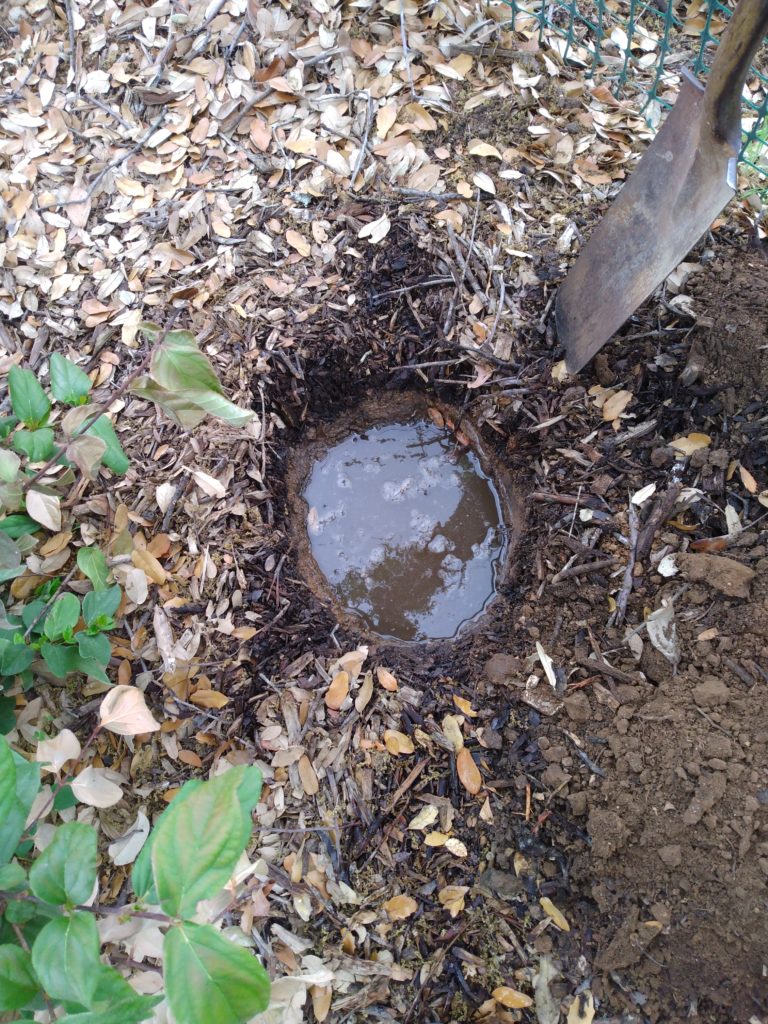
For most drainage implications, dig a hole that is one foot square and one foot deep.
If the soil is deep enough to dig a hole two feet deep with a post hole digger, that would be even better.
Fill the hole with water and leave it overnight to drain. You cannot get an accurate reading if the soil is already dry.
Fill the hole with water again the next morning, and measure the level drop per hour. Setting a ruler into the hole and checking the drop hourly is one method.
A 1″-3″ drop per hour is acceptable, while a 2″ drop per hour is ideal.
If the drop is less than 1 inch per hour, the soil is considered to be poorly drained.
If you discover that your soil is poorly drained, choose a tree that will tolerate poorly drained soils or “seasonal wetness”.
Another option in heavy clay soils is to “plant high”. Build a wide berm that extends out five feet for every foot it is raised, tapering down gradually to the existing grade.