
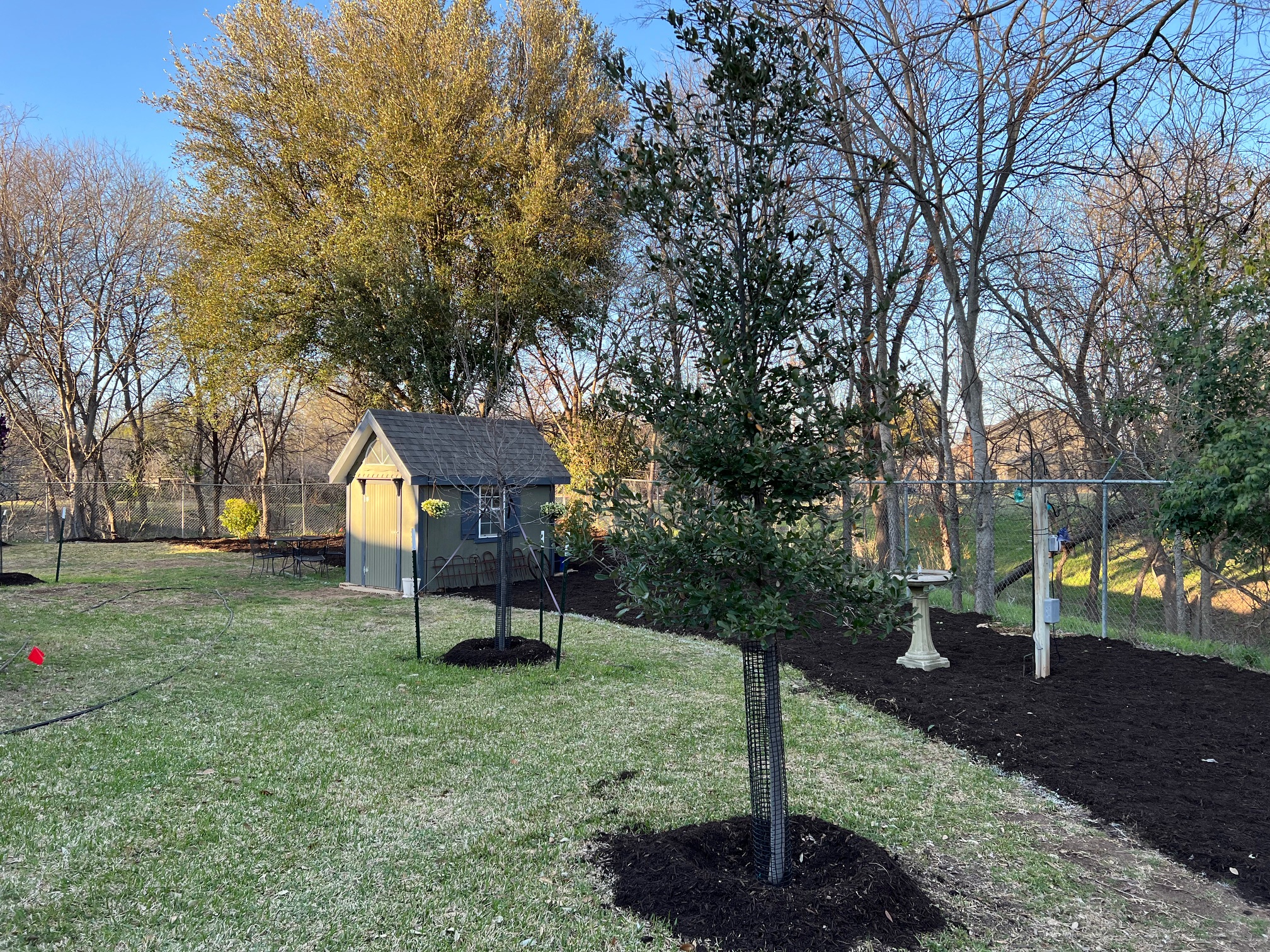
Planning a landscape prior to planting is key if you want your plants to be successful. There are several key pieces of information that you will need to bring to the experts at Backbone in order to receive a recommendation that will thrive in your landscape. Let’s go over the information to consider before choosing a tree, shrub or perennial plant for you landscape.
What type of soil are you planting in?
Central Texas has a variety of soil types, and each one has its own specific properties. Does your soil have lots of limestone rocks?
Is you soil a clay-based soil or does it have a clay layer under the top few inches? Some soils are mostly granite gravel, often with clay beneath. Some areas are in the “Blackland Prairie” which has a darker clay soil. Perhaps you live on top of a hill and have “shelf rock” below a shallow layer of topsoil. Perhaps you are in a subdivision that has had sandy loam “fill dirt” brought in by the builder.
Determining the soil type is key to knowing what to plant, as not all plants can tolerate all soil types. In the case of thin soils you may need to bring in soil to create a “berm” to plant on. Without accurate information we cannot make recommendations on what will thrive under your soil conditions.
Does your soil have good drainage?
Surface Drainage refers the slope of the land. If your planting area is at the bottom of a slope, seasonal rains will often saturate the soil. Certain plants can tolerate “seasonal wetness” and others, like Texas Sage and Rosemary, will succumb to rotted roots.
Internal Drainage refers to how well water from irrigation or rain penetrates the layer of soil that roots grow in. Since 90% of plant roots that absorb water and nutrients are in the top one to two feet of soil, a soil drainage test will assist you in determining how well your soil drains. Be sure to perform the drainage test in the area that you will be planting in, as soil can change dramatically in some locations from one side of your yard to the other! Click HERE to learn about testing your soil for internal drainage.
How much direct sun will the area to be planted receive in the SUMMER?
Know the direction that the planting area faces to determine the amount of direct sun each area will receive. Morning sun is less severe than afternoon sun. Certain plants will perform better in part sun rather than a full day of sun. Remember that deciduous trees that are bare in the winter will provide “dappled sun” in the summer.
What type of irrigation will the area to be planted receive?
Many plants are prone to disease when they receive regular “overhead” irrigation. This is especially problematic when the irrigation is run at night and the leaves remain wet for extended periods. If a landscaped area is planted within the lawn irrigation zone wetting of the foliage by overhead irrigation may cause disease problems on certain plants. Entomospoium Leaf Spot on Photinia or Indian Hawthorne, or Black Spot or Powdery Mildew on Roses are commonly affected by overspray from lawn irrigation.
What are the measurements of the area to be planted?
Avoid planting smaller plants too close together. Spacing plants according to the mature width eliminates having to remove crowded plants later, or having to treat for disease because the plants lack air circulation. Remember, a plant in a one gallon pot will grow to the same size as the same plant purchased in a 5 gallon pot. The size of pot does not determine spacing.