
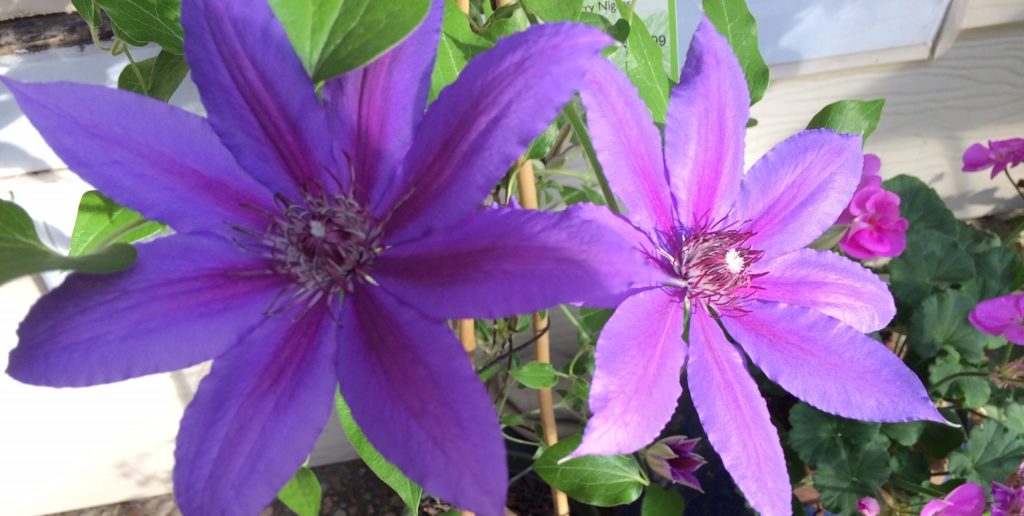
Clematis is a tidy vine with striking blooms that appear mainly in the spring in Central Texas. .
Whichever way you pronounce it, it is one of my favorite flowering vines, and I am excited to introduce it to you!
What conditions does Clematis require in Central Texas?
Clematis, in nature, germinate their seed in the shade of other plants, and climb into the sun, keeping their roots in more cool temperatures. Hence, the adage “tops in the sun, roots in the shade”. This can be accomplished by planting a shrub to shade the roots (Liriope works well), or even by placing a large flat stone over the root area. A thick layer of mulch also works, as long as the mulch is pulled away from the stems to prevent stem and crown rot.
Generally, I prefer planting these vines in about 6 hours of sun. I find planting the vines on an east exposure helps to prevent the sun and wind from drying out the blooms. Some varieties are adapted to partial shade, but all will benefit from some afternoon shade in the heat of Central Texas summers!
Clematis are deep-rooted, so water thoroughly when you do water.
Successful pruning is determined by bloom period, and has been separated into the following groups:
Group 1, or early-season-flowering Clematis, flower on old wood. They require no pruning except to control size.
Group 2 bloom first in early summer on short shoots from last season’s wood and some flower again in late summer on new growth. Prune lightly before bloom in spring to shape and remove weak growth, then prune lightly after bloom if desired. Most of our clematis fall into this category.
Group 3 plants flower in late summer on growth made in that season. They may be cut back to a pair of strong buds about 12” from the ground in late winter/ early spring.
Newly planted Clematis should be kept pruned to 18”-24” the first year to allow the top growth and root growth to develop proportionately. Allowing the plant to produce one long spindly vine will take years to establish and produce heavy blooms. Pruning the first year also allows the plant to develop from multiple stems and buds from below ground. The future rewards are worth it!!
Clematis tend to be heavy feeders. Timing of fertilizer application is important.
If you feed Clematis while it’s already in bloom, the flowers will likely abort. Therefore, you should fertilize in early spring before the buds start to swell, since this timing gives the plant the nutrients it needs for strong growth. For best results, choose an organic fertilizer such as Happy Frog Fruit and Flower, or, if you prefer, use a liquid option like Fox Farm’s Tiger Bloom.
Here are a few popular varieties:
‘Comtesse de Bouchaud’ produces 6” rose-pink flowers on a vine 6’-10’ long. It is excellent for a trellis and flowers late in the summer. It is in pruning Group 3. (Zone 4)
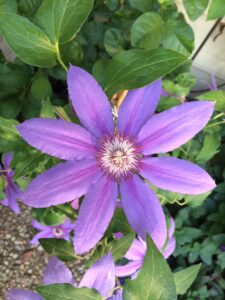

‘Dr. Ruppel’ sports early, large, delicately ruffled, pale pink flowers with a deep reddish-pink central stripe. The flowers take on lavender highlights as they mature. Flowering comes in two waves, first in late spring/early summer, then in late summer/early fall. Deadhead after the first wave of blooms to promote new blooms. It belongs in pruning Group 2. (Zone 4)
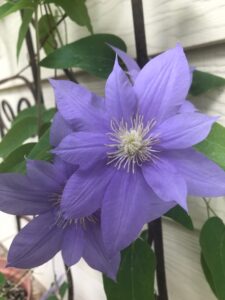
‘H.F. Young’ has stunning 6”-8” azure-blue flowers in late spring with a strong repeat at the end of the summer. It is in pruning Group 2. (Zone 4)
‘Rhapsody’ is a compact climber with sapphire flowers 4”-5” across. It will bloom from early summer to early fall, and is ideal for containers and trellises. It grows from 8’-10’ tall and 3’-4’ wide. It is in pruning Group 2. (Zone4)
‘Ernest Markham’ has striking 4”-6” wide bright magenta flowers from mid-summer to early fall. It is vigorous and quite florific. It is in pruning Group 3. (Zone 4)
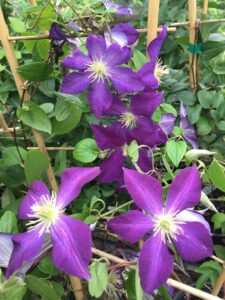
‘Jackmanii’ is a late-flowering Type 3 clematis which means it will bloom on growth produced during the current growing season. It is one of the longer blooming varieties. Prune annually in late winter-early spring just as buds begin to swell. May be cut back hard to encourage branching and new growth.
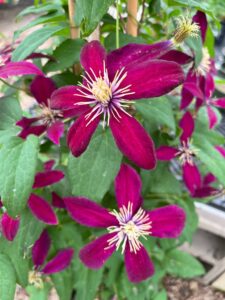
‘Niobe’ has huge, 5″-6″ dark wine colored blooms. Niobe falls into pruning Group 2 and flowers in May-June, sometimes repeating in late summer. Prune in late winter-early spring just as new buds show. Remove only weak or dead/damaged stems.
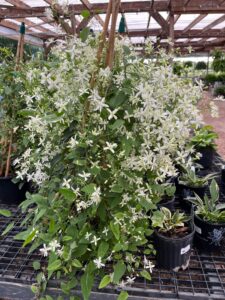
For a slightly different look the fall blooming, vigorously growing ‘Sweet Autumn’ Clematis with its small white, highly fragrant flowers is a real show-stopper!